Q2 2019 Market Update

Around the Market: Q2 2019
The stock market is hitting all-time highs, buoyed by what it sees as a certainty that the Federal Reserve will lower interest rates late this month to try to stave off a recession. Years ago a friend explained to me that the Federal Reserve simply follows the market rate for the secondary market 90-day treasury rate when setting the fed funds rate. I’ve been following both now for a couple of years to check his theory, and I believe it’s largely accurate. The 90-day treasury yield stands today at 2% flat, which is.25% to.50% lower than the fed funds rate. So we’ll see soon whether the theory continues to hold. Yield curve inversion sometimes signals a coming recession. The 90-day treasury bill pays more than the 5-year treasury bond on the secondary market. This has likely been one of the most pressing concerns for the Fed, even with the economy growing, inflation tame, and the unemployment rate in the U.S. at 50-year lows. Most of the yield curve has inverted, but not all of it. The important 2-year to 10-year curve has yet to invert. The two points I would like to make are, 1) the coming Fed rate cut is already priced into the market, and 2) we are likely nearing the end of the expansion phase of the economic cycle.
Related to the second point is the following chart. Imagine a company (brokerage) that makes its money from management fees from mutual funds, and from the commissions and fees from selling stocks and bonds, coming out with a report that the U.S. economy is likely at the end of the last stage of the business cycle. What happens normally at the end of the last stage of the business cycle? Stocks drop, decreasing fees and income to brokerages and mutual funds managers. Having followed Fidelity’s business cycle charts for years, I believe that they are true to the task and applaud them for publishing worthy content, despite the fact that it might mean less profits for them in the short run.
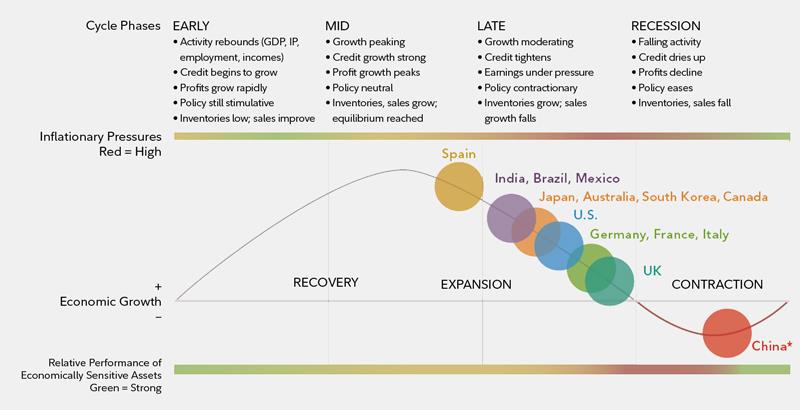
Notice on the chart the point at which the blue U.S. circle sits in between expansion and contraction. Then, look below at the color bar which represents “relative performance of economically sensitive assets”, (i.e. stocks). As you can see, if this chart is correct, the U.K., Germany, France, Italy and the U.S. markets should be entering the orange/red portion of the performance graph, which portends poor stock performance. China on the other hand is further along. Having had a tough, slowing economy in 2018 well before the trade tensions even began. China is now solidly in the contraction zone and almost ready to possibly enjoy the green recovery stage in share prices. This research concurs with what we have been finding from a valuation standpoint. U.S. equities are expensive, and we prefer not to purchase anything, stocks not excluded, when we believe they are overpriced.
Stocks We Like
Continuing with the rationale that China has already seen some rough times, there are a few opportunities that we have been attracted to due to their current value combined with future growth prospects. One is Baidu, the Chinese search engine leader. Baidu, has great positions in travel (through Ctrip,) has a majority of a Netflix type service called Iqiyi, is heavily into cloud services, and has the market leading AI technologies for autonomous driving - all of this along with 85% of mobile search market share. The stock trades for 2.6X sales and 13X last year’s earnings. Compare that to Google, which trades for double at 5.3X sales and 27X earnings and you can see the value difference. And Google is pretty cheap compared to where it has historically traded. Baidu had a high cost quarter that caused a small loss and the stock cratered. They are in an investment phase at the moment and I believe the long-term future is bright behind CEO Robin Li, who has deployed capital well in the past. A second Chinese stock we like is MOMO, the Match-like online dating service of China. They also own a Tinder-like site called Tantan, which they recently acquired. There is a significant male/female imbalance in China owing to the past one child policy. 15% of men in China in years 2020 to 2050 will find themselves without a wife. This is a real problem and MOMO has a business that solves it for many in an efficient way. Facilitating love and the matchmaking process should be a good business for a long time in China. The Chinese government recently blocked new Tantan downloads which caused lots of distress in the stock price. MOMO is working through the problem. This high growth stock trades for 2.9X sales, and 20X trailing earnings. They are investing heavily in growth which is robust. I believe the government setback will prove transitory. U.S. based Match has been a fantastic stock. For valuation comparison it trades at 11X sales, 40X earnings and is not growing as fast as Momo.
Interesting Facts
Discerning between fact and fiction, truth and myth is one of the challenges with successful investing. You may have heard about the ghost cities of China in the past and the real estate bubble there that was just waiting to explode. While doing some research about China, I ran across the following video clip from Matthews Asia, a prominent Asian fund company based in the U.S. It dispels the CBS special about ghost cities as inaccurate
https://us.matthewsasia.com/perspectives-on-asia/video-detail.fs?artID=922
Final Thoughts
We look forward to the day that we can feel opportunistic in deploying a larger portion of assets into stock holdings. Currently we maintain a large percentage of dry powder. Sometimes it takes a high level of discipline and boldness to just say no to overpriced stocks. Concurring with our views is the following comment from the aforementioned Fidelity article, “As a result, even if the possibility of a prolonged late cycle has risen across some indicators, the potential upside for asset markets may not have improved materially. The late cycle remains a time for great uncertainty and a generally less favorable riskreward trade-off, implying a smaller overweight to risk assets than earlier in the expansion.”