Q4 2019 Market Update

Around the Market: Q4 2019
Making your dollar worth less is a priority of the government. Inflation could surprise on the upside this year. Last week’s Consumer Price Index report showed a 2.3% rise year over year for 12 months in the core cost of living index spurred by gas, medical costs and rent. I’m growing increasingly skeptical of the Bureau of Labor Statistics, Consumer Price Index (CPI), and even more so the Bureau of Economic Analysis, Personal Consumption Expenditures (PCE) Index (talk about a duplication of government!). Are these indexes really accurate indicators of inflation?
Business owners I speak with are regularly struggling to find employees. Wages are rising. From one report I read, services prices have been rising at 4% while goods prices are nearly flat. This makes sense. Services prices are rising faster due to increased labor shortage and wage gains, while goods are flat due to technological change and increased online purchasing which cuts out the middleman. Maybe the most telling figure is housing. Existing homes represent 90% of the housing market. The median sales price of an existing home rose 7.8% in the past 12 months. That’s inflation! In the past five years existing homes have increased in average price by 37% from $200K to $274K. Over the long term house prices have been tracked inflation. Why the wide disparity now?
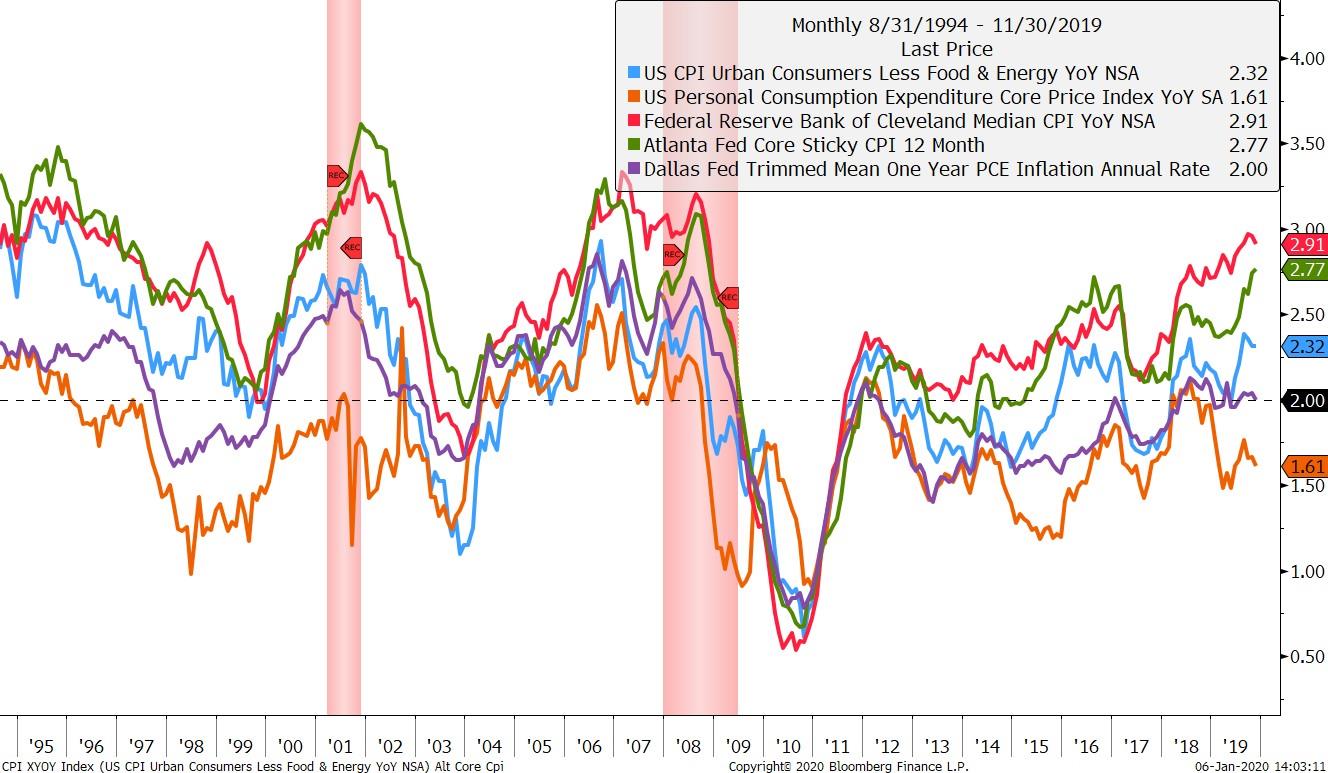
The chart below from DoubleLine shows several government inflation gauges from 1994 to present. The current inflation rate for each is listed to the right. The Fed’s favorite, not surprisingly, is the U.S. Personal Consumption Expenditure Core Price Index (PCE) which posted a 1.6% rate – by far the lowest rate of the measures.
Measures of Core Inflation
The Federal Reserve is nonplussed about inflation. The Fed “target” rate of 2% is eclipsed here by.3% by the topline U.S. CPI number. Chairman Powell, at the last open market committee meeting had this to say about inflation, “I think we would need to see a really significant move up in inflation that’s persistent before we would even consider raising rates to address inflation concerns.” To paraphrase, Even if inflation is above 2%, we want it, bring it on. We’re not going to do anything about it.” Ok maybe I embellish a bit, but the point is that the prevailing attitude is dangerously cavalier about risingprices.
As a result of side-pocketed inflation, I think we can expect short term interest rates to stay put this year. We may even see a cut or two in the fed funds rate if the economy gets shaky. However long-term interest rates, which were once entirely market driven and now are partially market driven (due to asset purchases by central banks), may see increases due to real inflation and consistently high federal budget deficits. Interesting. Even with approximately $12 Trillion dollars in negative yielding debt circulating overseas, we could see higher long term rates temporarily. We’ll be gearing our investment strategy around this thinking. What investments will get hurt by an increase in long term rates? Most of them; particularly long-term bonds and companies with lots of variable rate long-term debt. Housing and mortgage stocks probably get hit hard as well. Jeffrey Gundlach, in his DoubleLine Just Markets report, opines that he believes we will see a weaker dollar in 2020, a result of high budget deficits and the aforementioned inflation and Fed focus. In this case, what investments present opportunity in 2020? There are always great buy and hold companies here in the U.S. in isolated instances, but valuations are stretched. Many years of tepid inflation and ultra-low interest rates have investors paying up. The S&P 500 trades at a forward Price/Earnings ratio of around 20X, the highest valuation in 8 or 9 years. S&P earnings saw almost no growth in 2019 to accompany the perceived increase in value. Lauded stock picker Meryl Whitmer recently quipped in a Barrons article, “It’s pretty slim pickings for the value investor these days. We look at many companies, and the current stock prices are as high – or higher – than our target prices a couple of years out.” Commodities such as oil plays with solid balance sheets may benefit from a weaker dollar. Gold may work again. Emerging market stocks such as Chinese Internet stocks will benefit from a weaker dollar, though that does not mean they will appreciate in a bad market. There may be some limited opportunities in currency ETFs. Mortgage REITs should benefit as they borrow short term and lend long. Lastly, if the 10-year bond yield rises to 2.4% to 2.5%, there might be an opportunity to buy them, as a rise in long term rates will surely cause some chaos in bond and stock prices.
Joe’s Dynamic Investments
Why did I name my recently published book by this title? I wanted something non-intimidating, and I couldn’t think of anything better. You might not be the target audience for the book which answers questions like: What should a household budget look like and what’s a good savings target? What qualifies as a high return investment and how much of your savings should be allocated to them? Real Estate vs. Stocks vs. Bonds, which is better? Which is riskier? Is inflation here to stay? How to plan for it? Those are just a few of the topics. It’s likely beneath your pay grade, but if you know of any millennials/young couples that need direction, please see the Amazon link in the body of the e-mail and refer them to it (or buy them a copy).
Onward and Upward in 2020!
=SD