Q1 2018 Market Update

Market Outlook: Q1 2018
What a difference a quarter makes! As I posited in the Q4 newsletter, 2017 was the first year on record for the S&P 500 index to post a positive return in every month. It was a smooth, unusually easy road, and many forgot over the year what normal market conditions are. Reminders started in February as we have seen marked increases in volatility, large down drafts and yo-yo action in share prices. Thankfully, we are not traders.
Though the turbulence has been attributed to many causes, I believe the most reasonable are higher inflation expectations and long term interest rate rises, combined with the Federal Reserve's new goal of increasing the fed funds rate four times in 2018 rather than the previous three. Trade war talk is also a concern, but probably more smoke than flame.
The drop from January 26th to February 8th just exceeded a 10% correction and the S&P 500 currently sits around 9% off the January peak. While the overall market has been violent, most underlying individual stocks seem even more so.
Even so, with a few exceptions such as certain energy shares, bargains are in short supply. As you have probably read before in our newsletter, the overall market by most measures is at pricey levels, justified only by low interest rates. During times like this our strategy is to hold appropriate levels of cash or cash-like investments, while continuing our research disciplines to find the best value. I believe it is essential to have this “dry powder” at the ready to enable us to take advantage of downturns, corrections, and more reasonable prices when they inevitably occur.
More on ETFs and A Stock We Like – The Best Part
Newfield Exploration (NYSE: NFX)
Newfield Exploration Co. is a premier exploration and production (E&P) player in the SCOOP and STACK areas in Oklahoma. Based on our research, we believe the company is undervalued and worth owning at prices much higher than today's $24. The company has done a nice job over the past couple of years of offloading some non-core assets while making investments in their SCOOP and STACK core competency. More important to us is that they are newly committed to living within their cash flow means and focusing on project returns rather than production growth at any cost. The balance sheet looks strong for and E&P player. At $55 oil they should do fine, and at $60 - $65 the company should do quite well. One reason we believe the company is undervalued is current overwhelming investor community and analysts focus on the more prolific Permian Basin plays. A second reason follows.
In the Q3 2017 newsletter I wrote about the danger of owning stocks with high exchange traded fund (ETF) ownership percentage. Here is an excerpt,
“Why does high ETF ownership bother me? ETFs are by definition passive investments. ETFs are agnostic about the fundamentals of the basket of companies in which they own stock. Therefore, their investors are passive investors. I simply believe many ETF investors will lack the conviction to hold their investments through downturns due to having no idea about the underlying fundamentals of the stocks they own. The resultant panic selling will lead to a cascade effect in the prices of stocks prominently held by the ETFs - as they liquidate their positions to cover redemptions.
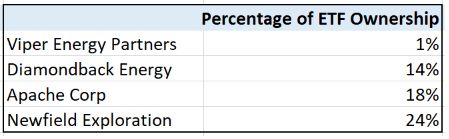
In the same newsletter we wrote up a company named Viper Energy Partners, a mineral rights company in the Permian basin. Newfield has high ETF ownership of around 24%. Viper has very low ETF ownership, almost zilch due in part to being a master limited partnership (MLP).
Both stocks are what I would call value stocks in the energy space. But take a look at the following chart that shows the difference in their performance over the past 3 months which includes the February sell-off. I have also added two more E&P companies that I like to the mix: Apache Corp (symbol: APA) with 18% ETF ownership and Diamondback Energy (symbol: FANG) which has around 14% ETF ownership.
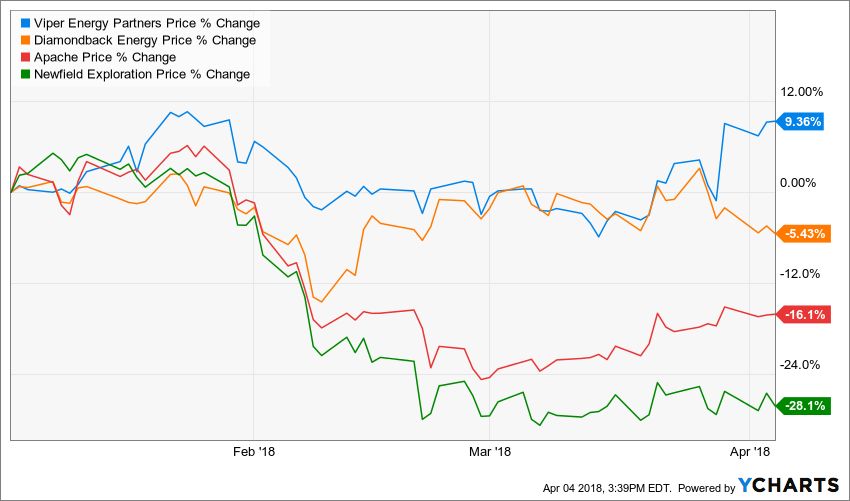
As is obvious, the higher the ETF ownership, the worse the stock has performed over the past 3 months and specifically during the sell-off. I'm not going to state that this chart proves our point about the toxicity of high ETF ownership in a downturn, but there is some evidence here that there may be truth to the theory. While each of the four stocks has its own fundamental characteristics, it's easy to make the argument that not much changed for each company over the 3 month period shown in the chart. We believe Viper Energy's shares would have decreased in price much more if it had 15-20% ETF ownership. All four companies benefit from higher oil prices. The West Texas Intermediate (WTI) oil price over the 3 months increased from $60 to a current $65 per barrel.
So while Newfield's shares obviously suffered mightily during this recent correction (down 25% over 3 months), maybe the high ETF ownership is one of the reasons the stock is having trouble bouncing back despite higher oil prices. This leads to our next point. While it may be dangerous to own a stock with high ETF ownership prior to a correction or down turn, high ETF ownership may cause a stock to become more of a buying opportunity after a correction or dip. That's where we believe we are with NFX. It was an neglected orphan before the dip, and it's an abandoned outcast afterwards. It's shares have been further distanced from their true worth like a balloon held under water. When the market might release the balloon, no one can tell.
Final Thoughts
Many thanks to Brittany Rowland and Brian Jones for their valuable ongoing contributions to research and technology.
Thank you for investing with Fortunato. It's a pleasure to serve you. No matter what the future holds, there will be excellent opportunities to invest in great companies.