Q2 2018 Market Update

Market Outlook: Q2 2018
All is as it should be in the late part of the business (debt) cycle. Interest rates and oil prices are rising, and we may even see some wage inflation coming from full employment soon. For overseas markets, dollar denominated variable rate debt has become a hindrance to some emerging market companies due to a strong dollar, and rising interest rates. Though I am a stock picker and not an economist, I enjoy reading about it. One interesting early economic indicator I wish to highlight may surprise you.
The economy is strong, the labor market is tight, folks are getting raises and generally everyone is making more money. The personal savings rate is rising because people's earnings are increasing faster than their spending. Right? Nope, not even close. Maybe it's only an American phenomenon, but the personal savings rate actually declines under this positive economic backdrop, because Americans spend more. We take on more debt, and we spend like Clark Griswald in Hollywood. Wahoo! And this is why the savings rate is an early economic indicator.
Currently, the personal savings rate sits at 3.2%, up slightly from a recent low of 2.4% in December of 2017. The personal savings rate in November of 2007 when the market peaked in the last cycle was 2.5%. Notice the similarity of the bottoming savings rate below.
If that seems really low to you, it should. Take a look at the following graph provided by your Federal Reserve:
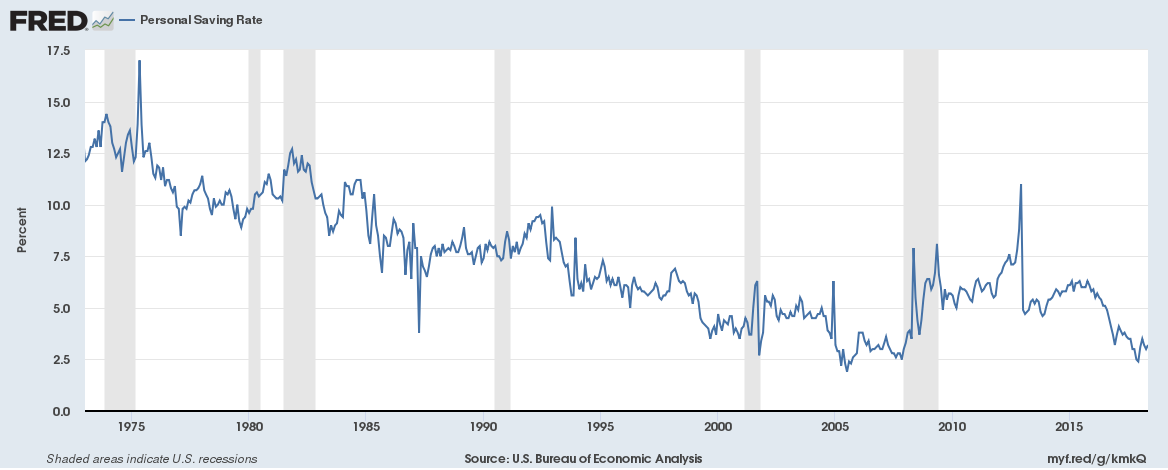
There is no such thing as a perfect economic indicator, but as you can see from the graph with the gray vertical recession bars, the personal savings tends to decline prior to a recession. Which, when you think about it, makes perfect sense. People take on a bunch of debt when spending too much, then they must buckle down and save more to pay back the debt from the, “good time” purchases. A couple of related quotes I recently ran across that ring true state, “Debt is future consumption denied,” and “Excessive debt is economic stagnation ensured.” When it's time to stop borrowing more and start paying back more, recessions occur in our debt-based economy.
One last comment on this. According to a Reserve Bank of Australia report, China's household savings rate is over 30% and has increased with economic growth. Australia's household savings rate has recently been as high as 15%. Something to think about.
We continue to like stocks of companies in industries that typically do well in the late cycle. These include energy and commodity producers. With a few exceptions, bargains are in short supply. As you have probably read before in our newsletter, the overall market by most measures is at pricey levels, justified by low, but rising, interest rates.
During times like this, our strategy is to hold appropriate levels of cash or cash-like investments, while continuing our research disciplines to find the best value. I believe it is essential to have this “dry powder” at the ready to enable us to take advantage of downturns, corrections, and more reasonable prices when they inevitably occur. Currently, we are even researching companies that we believe will do well during the initial leg of the the next up cycle.
A Stock We Like
Last quarter in the “Stocks We Like” section I concluded with the following paragraph in relation to an investment opportunity in Newfield Exploration (NFX), after the stock took a big hit during the 1st quarter market correction despite rising oil prices:
“So, while Newfield's shares obviously suffered mightily during this recent correction (down 25% over 3 months), maybe the high ETF ownership is one of the reasons the stock is having trouble bouncing back despite higher oil prices. This leads to our next point. While it may be dangerous to own a stock with high ETF ownership prior to a correction or down turn, high ETF ownership may cause a stock to become more of a buying opportunity after a correction or dip. That's where we believe we are with NFX. It was an neglected orphan before the dip, and it's an abandoned outcast afterwards. It's shares have been further distanced from their true worth like a balloon held under water. When the market might release the balloon, no one can tell.”
What has happened since? The market has somewhat “released” NFX stock and it has appreciated 23% since publishing the last newsletter.
Investor Highlight / Shelby Cullom Davis
A couple of times a year we highlight an investor with an extraordinary record. Shelby W.C. Davis took over as manager of the New York Venture fund in 1969 and amassed an excellent record as a stock picker. A $10,000 investment would be worth $379,000 28 years later. He beat the market 22 out of 28 years as a manager. However, this investor highlight is not about him, it's about a man with a much better record – his father. The former Davis lived an intriguing life. He quit a secure job working for the New York Insurance Department in 1947 and decided to become a full time investor with a $50,000 start up sum from his wife's family. After 45 years of investing successfully at 23% to 24% average annual returns, that sum purportedly totaled around $900M. He was an acquaintance later in life with Warren Buffet, but he had a stock picking style all his own. He purchased mainly insurance company stocks, an area of personal expertise, and he often used margin debt. He was notoriously tight with his money as so many great investors are, and he was clearly what we today call a value investor – sometimes paying 50 cents on the dollar for the net asset value of shares of insurance companies. Though he had no business schooling, nor an MBA, he understood well how money could multiply over time, and frequently called the companies in which he invested, “compounding machines.” One of the most interesting twists of Davis' life as an investor was his failure in the brokerage business in 1947 and 1948. He crisscrossed the country speaking about the excellent value in insurance stocks, and hoping the investors would buy through a small brokerage he had purchased – earning him a commission. Without success in selling the investments to others, he just started purchasing them himself, following his own advice, often with maximum margin. His investments were fairly concentrated often owning around 7 stocks at a time. He kept little in the form of records or notes and was once quoted as saying, “You make most of your money in a bear market, you just don’t realize it at the time.”
Final Thoughts
Many thanks to Brittany Rowland and Brian Jones for their valuable ongoing contributions to research and technology.
Thank you for investing with Fortunato. It's a pleasure to serve you. No matter what the future holds, there will be excellent opportunities to invest in great companies.