Q1 2017 Market Update

On the Horizon: Buffett Misquoted
On the Horizon -Buffett Misquoted
Just reading a headline can be misleading. Understanding the full context of a comment or a business and where it is in its cycle or industry is critical when making investments.
Recently CNBC, Barrons and other media posted a quote by Warren Buffett that took the Oracle of Omaha's thoughts and comments out of context. This occurred during a recent February 27th interview with CNBC and it is a classic case of selective hearing, and sensationalist media. Buffett used the word “cheap” in connection with stocks when talking about the market. Many media outfits immediately printed sensationalist headlines such as, Buffett: Stocks are, “actually on the cheap side.” Below is the actual transcript from that section of the interview:
Interviewer Quick: “Although you have had times where you thought stocks were incredibly cheap, like in 2008, 2009, when you talked about that, even on our program. You thought that there were times that stocks were greatly overvalued where you've said, ” " Forget it, don't do it."” Are we near an inflection point right now, as best as you can tell?” Buffett: “Well... I've been talking this way for quite a while, ever since the fall of 2008. I was a little early on that actually. But I don't think you could time it. And we are not in a bubble territory or anything of the sort. Now, if interest rates were 7 or 8 percent then these prices would look exceptionally high. But you have to measure, you know, you measure everything against: interest rates, basically, and interest rates act like gravity on valuation. So when interest rates were 15 percent in 1982 they'd pull down the value of any asset. So, what's the sense of buying a farm on a 4 percent yield basis if you can get 15 percent in government's? But measured against interest rates, stocks actually are on the cheap side compared to historic valuations. But the risk always is, is that — that interest rates go up a lot, and that brings stocks down. But I would say this, if the ten-year (treasury bond) stays at 230 (2.3%), and they would stay there for ten years, you would regret very much not having bought stocks now.”
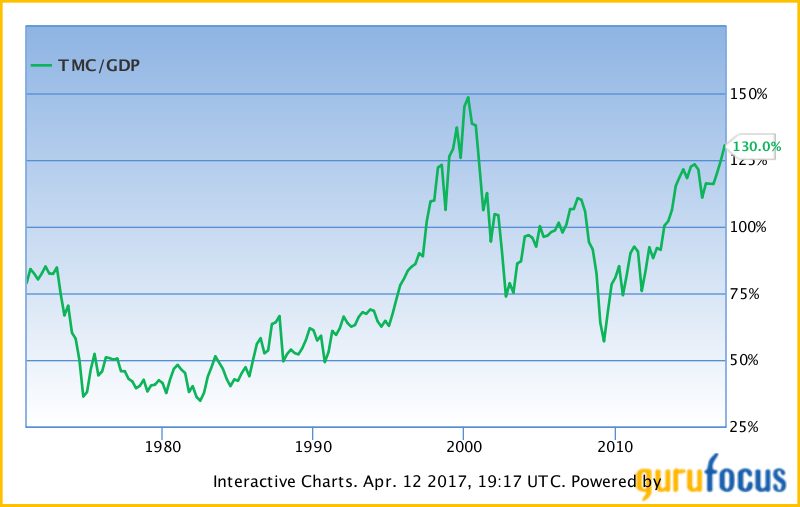
As is obvious by the underlined full sentence in which Buffett made this comment, only as measured against interest rates can one say the market overall on the, “cheap side.” Another way to think about this is, 10 year treasuries (at a 40 P/E multiple) are comparatively more expensive than stocks. Both asset classes are historically expensive, propped up by easy Fed policy since the financial crisis. By Buffett's favorite measure of stock market valuation, Market Capitalization to GDP, the market is one of the most expensive in history (chart below). But ever the optimist and promoter, and having recently placed $20B in Apple and the airlines, Buffett classically touts the vehicles in which he has just placed his funds.
Back to the CNBC interview. The interview was largely about Buffett's recent letter to shareholders and purchases in Apple and four airlines. It's worth noting that these were two good value areas of the market, but he made the comment that they had both risen in price recently and that he would not be buying either at current prices. What we can conclude from this is; if you can find companies with positive attributes and potential that are selling at good prices, they are still worth buying. And secondly, as an investor, it's always more intuitively convicting to think of owning a share of a business, than it is to think of owning the stock market as a whole.
It's not impossible to find good value in certain sectors and stocks and countries, but it's definitely becoming more difficult. This is one of the reasons the Fortunato strategies are sitting on lots of cash, normally 50% or more in client accounts. There will be opportunities ahead in which the cash on the sidelines will be important.
The Best Part, A Stock We Like….
LGI Inc. (NASDAQ: LGIH)
LGI is a small capitalization homebuilder based in Texas with around $655M in market cap. Though the company has a majority of its presence in Texas – particularly Houston and Dallas, they are branching out into other states as well. The company posted excellent growth rate numbers in 2016 of 41% growth in income before taxes over 2015, and 33% growth in home sales revenues. The average LGI home price increased 8.8% in 2016, this will be a statistic that I will keep a close eye on going forward. Land and construction prices have been increasing in the home building space countrywide, so if the company is unable to pass through price increases to customers, that would be a strong sell signal. The company had record home closings in December and the for the fourth quarter. However, in early 2017, LGI has fallen behind its year over year homes closed number in January and February and for the first quarter. As a result, the stock has been volatile, jumping at year end only to fall back to just north of $30. Due to concerns about rising interest rates, the January and February closings being down, and a general distaste in the market for home building stocks, LGI trades at a very inexpensive 8.9X last years earnings compared to an industry average of 13.3X. LGI's forward P/E is 8X compared to the S&P 500 forward P/E of 19.6X. So here we have a stock with a P/E of less than half the market, with more than triple the market's growth rate (albeit trailing). My kind of stock! The lower closings to start the year are certainly something to watch, but management did not lower guidance for the year and on their most recent conference call gave credible reasons for the lower closings (simply building inventory). Speaking of management, LGI has a few strategies that are unique and enable them to earn a higher return on capital than competitors. For example, they build houses at the low end of the market with the average for 2016 being around $200K. They target apartment renters with their advertising rather than compete with other home-builders for more established buyers. With the average 2-bedroom apartment rental fetching $1250, the pitch to this segment is enticing. A second piece of the companies strategy is not sitting on a lot of land for extended periods, they purchase it and build as they find it. Lower corporate tax rates could be a nice benefit to LGI as the company pays around 34% currently.
Recent Articles
In February I wrote a piece for Seeking Alpha entitled Dividend Stocks are (or will be) the Bubble in this Market Cycle In the article I point out 4 specific stocks that are rich in valuation and considered stable dividend payers. I realize using the word “Bubble” makes me guilty of a sensationalist title, just like I criticize above. Seeking Alpha gave it an Editors Choice rating anyway.
Our Strategies, Fees, Costs and Alignment
We manage separate accounts for clients with three fund strategies. We have a low expense structure. Fortunato pays all its own operational costs including audit, legal, accounting, administration, tax and filing fees. None are passed on to investors.
Final Thoughts
Thank you for investing with Fortunato. It's a pleasure to serve you. No matter what the future holds, there will be excellent opportunities to invest in great companies.