Q1 2020 Market Update

If Not Now, When?
If Not Now, When? "Can't you understand what's happening here? Don't you see what's happening? Potter isn't selling. Potter's buying! And why? Because we're panicky and he's not. That's why. He's pickin' up some bargains. Now, we can get through this thing all right. We've, we've got to stick together, though. We've got to have faith in each other."
George Bailey (Jimmy Stewart)
"It's A Wonderful Life" (Frank Capra - 1946)
While the covid-19 virus has done damage to economies around the world, the biggest havoc has been reaped by societal and policy responses toward travel, business closings, social distancing, and isolation. I’m not stating these measures are not necessary to deal with the virus, simply that they are destructiveX10 degrees to the economic welfare of the country and world. There are two essential ingredients to wealth creation (GDP) for an economy - trade and innovation. Substitutable terms are transactions and productivity. Trade (transactions) is taking a major hit for most types of businesses which will ripple through the economy in unknown ways. The models our system works on is not set up for this.
Similarly, the models used in the financial world to project earnings and cash flow are not flexible enough to handle a two- or three-month gap of complete uncertainty. A recession is virtually guaranteed. I believe it will be a shallow one. Our housing and banking sectors are much healthier upon entry.
Yesterday, I called Fidelity to liquidate some Treasury bills in my account so that I could buy some stocks. I dialed them because my online orders to sell the bonds would not go through. When I spoke to the representative, he said everyone had been selling stocks and buying treasuries. Well, that much is obvious by looking at share prices and the averages. The S&P 500 was down 31% peak to trough so far. The following is posted on the front page of the fixed income section of Fidelity’s web site:
Recent extreme market conditions have resulted in a lack of liquidity, wide spreads (the difference between the price a customer can buy and sell a bond), large swings in prices, and substantial increases in pressure on trading systems. This can make it very difficult to determine fair and reasonable pricing on bonds. Fidelity continues to monitor the market environment and make every effort to ensure a fair and reasonable market for our customers.
If the largest brokerage can’t handle it…that is evidence of some major dislocation and dislocation creates opportunity. You see some crazy things that don’t make sense: Individual stocks dropping 40% in a day, Solid ultra-low-risk dividend investments paying 6.5%, the entire utilities sector rallying 13.5% in a day, the 10-year treasury shedding 75 basis points to yield.5%, the muni bond market tanking today, one stock we bought was down 45% yesterday and up 75% today. So much for the efficient market hypothesis. You don’t see what’s really going on just looking at the market averages. The volatility is incredible. This reminds me a lot of October and November 2008. The speed of the drop has been breath taking.
As I wrote in last quarters newsletter, “many years of tepid inflation and ultralow interest rates have investors paying up. The S&P 500 trades at a forward Price/Earnings ratio of around 20X, the highest valuation in 8 or 9 years.” This market was super expensive going in, so a fast drop when a calamity struck doesn’t surprise me. We were 75% cash and equivalents going in. We’ve since been deploying cash into companies we like on this massiveweakness.
How Low Will It Go? Who knows for sure? There are too many unknowns and variables in even the near future to gauge the economic destruction from this disruption. The market is an excellent leading indicator, and its decline will inform us about how bad the recession is going to be. But let’s look at past crisis/recessions/depressions/bear markets back to 1929 for a barometer on what could happen and just for fun speculate on what this could look like.
Duration Bear market Recession 1-Year return Peak Trough (months) magnitude during bear? after trough
9/3/1929 7/8/1932 34 -86% Yes 124%
3/10/1937 4/28/1942 61 -60% Yes 59%
10/9/2007 3/9/2009 17 -59% Yes 68%
3/24/2000 10/9/2002 31 -49% Yes 34%
1/11/1973 10/3/1974 21 -48% Yes 38%
11/29/1968 5/26/1970 18 -36% Yes 44%
8/25/1987 12/4/1987 4 -34% No 23%
5/29/1946 6/13/1949 37 -30% Yes 42%
12/11/1961 6/26/1962 6 -28% No 33%
11/28/1980 8/12/1982 21 -27% Yes 58%
2/9/1966 10/7/1966 8 -22% No 33%
8/2/1956 10/22/1957 14 -22% Yes 31%
7/16/1990 10/11/1990 3 -20% Yes 29%
09/20/2018 12/24/2018 3 -20% No 37%
Average 22 -39% 47%
            As we can see from this chart, the average peak to trough decline was 39%.
            Let’s say we are no-doubt-about-it entering a recession. The average decline
            then increases to 43.7%. Consider that we are coming off the longest bull
            market ever, at least since sharp records have been kept - over 110 years.
            However, it was a slow growth bull market…in fact the slowest. Still, we
            had zero bound interest rate policy for 80% of the run, which stoked high
            asset prices. We needed a 15% decline just to get back to somewhat
            reasonable stock prices. We’re at a total of 31% decline at the moment. Yet
            we’re only a month in and the average decline is much longer. But wait, the
            Fed is pumping huge volumes of money into the markets. OK, I’m going to
            put my foot in the sand at around 43.7% as my best guess. What an exercise
            in futility.
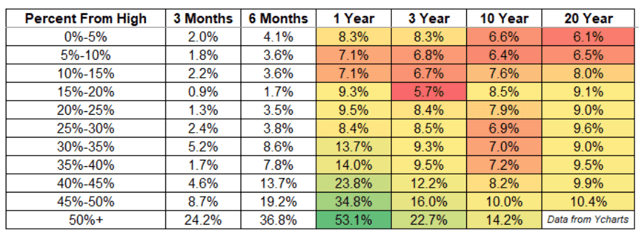
The Bigger the Decline the Larger Future Returns
Market declines since 1950
Self-explanatory enough. The farther it falls, the harder it snaps back…
Oil Market Chaos
A Saudi sheik and Russian diplomat are hanging out clanking a glass of apple juice and vodka right now. The production “war” between the two is laughable. At just the right moment, when it’s clear there will be a massive drop in oil demand caused by covid-19 induced travel restrictions, they decide to have a fight and go all out on production. Could this be stratagem to deal a death blow to the American oil producers? Nah. They wouldn’t do that. They are nice guys. They love us, right? America is now the largest oil producer in the world and now has pipeline access to ports for shipping out of the country. I’m sure that doesn’t bother them.
But what OPEC may not comprehend is that this will not be the death blow to the U.S. oil industry. Large strong companies with better balance sheets and less leverage will take over the ones that go bankrupt. And production will resume its growth when prices recover to something reasonable. Brent crude, the global benchmark, is currently at $27 per barrel. That’s less than U.S. producers need for positive cash flow, but there are many that can survive it. The cure for low oil prices is always low oil prices.
Quotes from some of the Best Ever I wanted to leave you with a few favorite quotes that have particular pertinence during these times.
“Bull markets are born on pessimism, grown on skepticism, mature on optimism and die on euphoria. The time of maximum pessimism is the best time to buy, and the time of maximum optimism is the best time to sell.” John Templeton "I will tell you how to become rich. Close the doors. Be fearful when others are greedy. Be greedy when others are fearful." - Warren Buffett
"In investing, what is comfortable is rarely profitable." - Robert Arnott
"The stock market is filled with individuals who know the price of everything, but the value of nothing." - Phillip Fisher
"Know what you own, and know why you own it." - Peter Lynch
“You get recessions, you have stock market declines. If you don't understand that's going to happen, then you're not ready, you won't do well in the markets." - Peter Lynch
Onward and Upward in 2020!
=SD