Q1 2023 Market Update

Today’s Bank Crisis
During the GFC (Great Financial Crisis) of 2008 the Federal Reserve Bank increased deposit insurance from $90K per account to $250K per account. By the end of that crisis in 2009 around 75% of bank deposits were insured. Today only 55% of deposits are insured – a result of a tripling of the money supply without a corresponding increase in FDIC insurance limits.
The GFC was caused by loose lending standards resulting in issues of solvency relating to massive tranches (MBSs and CMOs) of underwater subprime mortgages sitting on bank balance sheets. When marked to market, many banks were not solvent. It was a credit quality crisis. The rescue program for large banks was called TARP. The public was outraged at this $426B rescue program for the largest banks (on which the government ended up making $15B).
The cause of the current regional bank run is very different. It’s a crisis of fear of losing one’s uninsured deposits. Credit standards are much tighter and credit quality is by and large not a problem currently. This is the first significant bank run I can find on record for non-credit related reasons since the Great Depression.
Signature Bank Takeover
The well publicized depositor run on Silicon Valley Bank (SVB) was due to 1) a large number of uninsured depositors (those with more than $250K per account), 2) a huge percentage of Held to Maturity (HTM) long term bonds, and 3) fear caused by the Silvergate Capital crypto run. Even though SVB’s bonds were in safe assets such as U.S. bonds, there was a realization that there were large losses in the mark to market portfolio. Depositors with more than $250K in an account simply feared losing their capital. The takeover of SVB by Federal regulators occurred on Wednesday March 8th.
It's of extreme importance to note that at the time of the takeover. The Federal Reserve Bank and U.S. Treasury did not guarantee uninsured depositors. That did not occur until a release issued on March 12th and 13th. Many start up and mid-size companies that banked with SVB with uninsured deposits wondered how they would make payroll, or whether they would be able to retrieve their funds. This caused a fear-driven panic propagated by social media outlets. Every business in America with uninsured deposits started to question their bank. Regional banks that are not considered too big to fail and have a large number of uninsured deposits, started to see huge outflows. First Republic Bank was cited as the next to potentially fall due to a similar combination of deposits and HTM assets as SVB.
Signature Bank had many uninsured depositors (87%) due to the fact that they banked larger companies. But it did not have a problem with Held to Maturity assets. Capital ratios were healthy at around 8%. The bank had 60 consecutive quarters of profitability even through the 2008-09 financial crisis. It was the 20th largest bank in the U.S. and had a fantastic growth track record. Return on equity and assets was superb and routinely bested competitors. The efficiency ratio was an industry best 35%. The loan portfolio was in excellent condition with little in the way of non-accruals, and losses. It was an extremely well-run bank with a successful model. To counter any potential problems with liquidity (depositor withdrawals),
Signature had at the ready cash and available for sale securities of $4.5 billion and $26.4 billion that easily could have been used to fund withdrawals. In addition, they could have tapped their $30 billion FHLB facility to fund more outflows. That’s $60B in available funds vs. $80B in total deposits. We calculated that they could conservatively fund half their deposits in the event of a run.
The stock of Signature was rated a moderate buy on Wall St. with a $180 average price target as of Friday March 10th.
So why the takeover? As large business depositors feared losing their uninsured funds and withdrew them from regional banks, they withdrew $17.5B from Signature by Friday March 10th (over two days) in a social media driven frenzy. This was likely exacerbated by a March 10th FDIC release which explicitly stated that uninsured depositors at SVB would receive a receivership certificate for which they “may” receive future dividends. However, as discussed above Signature was still solvent. Following is a release from the New York authority:
The New York State Department of Financial Services (aka New York’s
bank regulator) made a rash decision when seizing Signature Bank on Sunday March 12th, one day before the Federal Reserve Bank and U.S. Treasury guaranteed all deposits at Silicon Valley Bank and opened the BTFP (HTM swap) program. It was just pure government overreach, a regulator with a hammer wanting to nail something because it could. The New York regulators cited a “crisis in confidence,” as the reason for the takeover. Stock trading in Signature was frozen/halted on Friday March 10th. How does taking over a bank and wiping out shareholders stem a banking crisis in confidence? It doesn’t make any sense. Taking over a bank and announcing them as a failed institution has the opposite effect of restoring confidence. Why would an insurance fund regulator take over a solvent bank because uninsured depositors are withdrawing funds? It accomplished nothing but wiping out shareholders and selling the bank’s assets at a huge discount.
The reason for the run on Signature and all the regional banks is clear. When the FDIC seized Silicon Valley Bank, the Fed and Treasury did not immediately address backing uninsured depositors even though around 45% of all U.S. deposits in banks were and are still uninsured. Instead, the FDIC came out with a release on March 10th that threw gas on the fire, “Uninsured depositors will receive a receivership certificate for the remaining amount of their uninsured funds. As the FDIC sells the assets of Silicon Valley Bank, future dividend payments may be made to uninsured depositors.”
https://www.fdic.gov/news/press-releases/2023/pr23016.html
Had New York regulators allowed Signature Bank to open on Monday the 13th after the Federal Reserve/Treasury release addressing the two problems, we are 99% certain they would have survived.
Lastly, who benefited from the takeover by regulators? The only parties to benefit are the banks that buy the loans and deposits at a big discount. In Signature’s case, United Community Bank stepped in immediately, bought on the cheap and the stock shot up 37% in a day. The FDIC came out with a notice recently saying it may lose up to $20B on the SVB takeover, but expected less than $2B in losses from Signature Bank. We doubt it will even lose that, even after dumping the assets.
Many posit that the real reason for the takeover was Signature’s willingness to bank crypto exchange deposits. In other words, they were made an example of simply because they accepted these deposits.
We know that luck plays a part in investing, and unfortunately, we stepped on a land mine with Signature in March (though we had owned it for more than a year).
Turmoil = Opportunity
Although my eyes were still watering from the Signature Bank takeover, we were able to pick up some great buys in quality non-bank financials that do not suffer a possible regulatory overreach or bank run. There may be more of these opportunities to come.
The Money Supply Conundrum
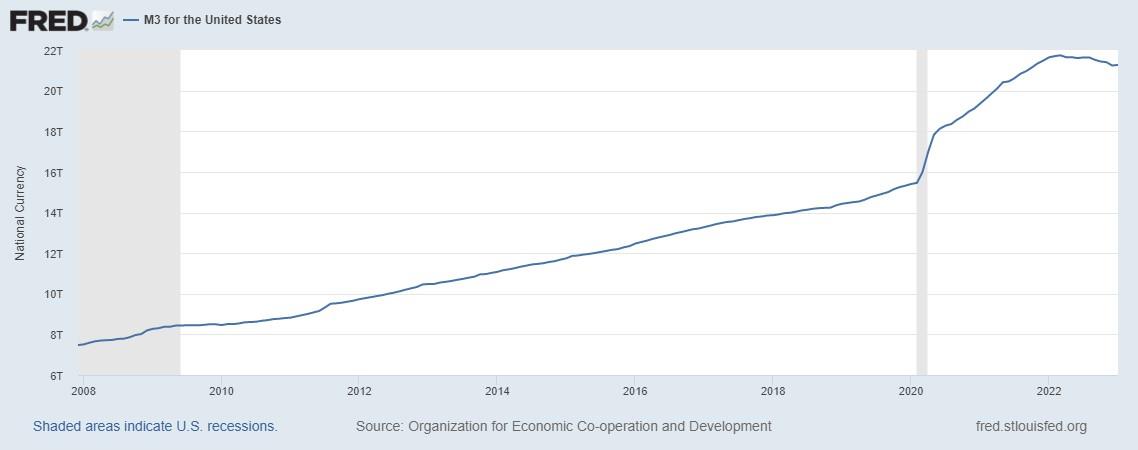
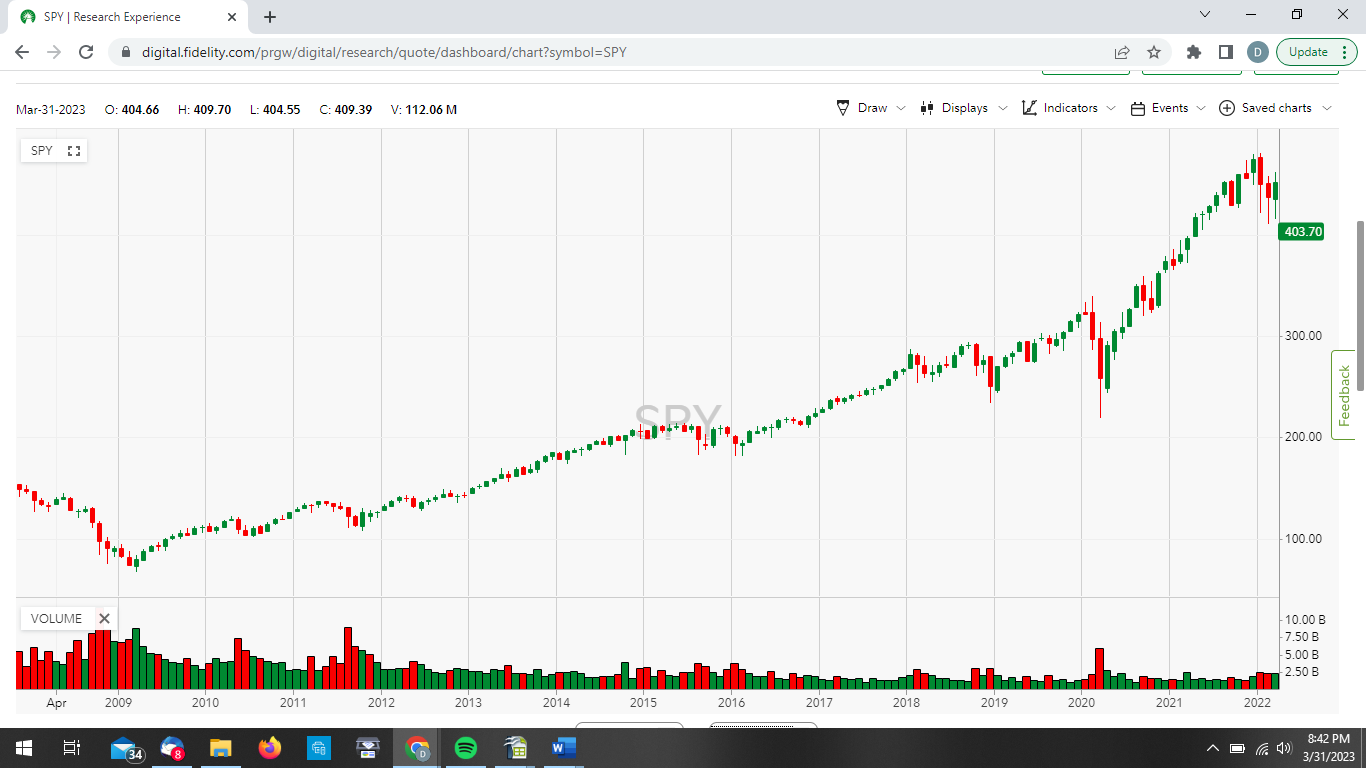
The Money Supply (M3) was up 290% from December 2007 to February 2022 due to quantitative easing and Federal government program spending. The S&P 500 was up 312% over the same period. Coincidence? No, no way. The two are directly correlated.
Money Supply End of 2007- Start of 2022
S&P 500 Same time Period
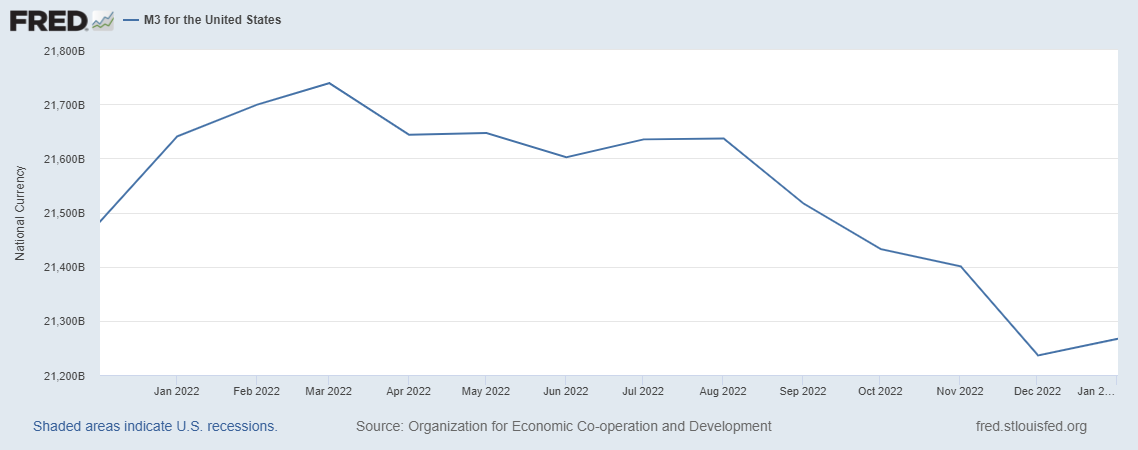
Recently the Fed has begun shrinking its balance sheet which has the effect of lowering the money supply (quantitative tightening). So far, it’s only down 3% since early 2022:
M3 Money Supply since December 2021
If the money supply were to decline 10% from peak, that, in tandem with an expensive market would make us circumspect about the prospective opportunities for stock prices, regardless of rising or falling interest rates. Currently, we have a very expensive market in the top 10 growth names in the S&P, trading 50% expensive to past averages. Conversely, small and mid-cap stocks look attractive trading 15% or more cheap to historicalvaluations.
Value stocks have been poor performers in 2023. Value investing, shown by both by studies and data, is proven to be the best long term means of investing. As we deploy capital at better prices in value-driven free cash flow generative businesses, we will in time see the benefits of our strategies re-emerge.

All investments involve risk, including the possible loss of principal.
The comments, opinions and analyses expressed herein are for informational purposes only and should not be considered individual investment advice or recommendations to invest in any security or to adopt any investment strategy. The opinions and analysis are rendered as of publications date and may change without notice. The information provided in this material is not intended as a complete analysis of every material fact regarding any security, country, region, or market.