Q3 2018 Market Update

Q3 2018 Market Update
The idea is the buy shares of companies when they are significantly undervalued, then try to hold them as long as possible, until they reach a level above our fair value estimate.
Lately, the market rise has been carried primarily by a group of tech momentum stocks that are trading at multiples that we consider dislodged from value, even with their robust growth rates. As such, those stocks are not only not on our radar, they are an area we want to steer well clear of.
The reason is that during down-turns (if we ever get another one), stocks that have been bid up to high valuation multiples tend to take a severe beating while stocks in beaten down, or under-favored sectors tend to perform comparatively very well. That's one reason we are favoring the energy oil and gas sector currently. It's fairly priced. Though the sector has rallied slightly this year, there are many companies trading at good value. A second reason we like oil producers is that this industry typically does well in the late stage of the economic cycle.
Further Thoughts on the Market
Here we are with three months left in the year and the U.S. Market has a slight rally going even after the correction in February. Until the last few days, the market has shrugged off news of trade wars, FBI investigations, tighter money supply, and a nasty emerging markets downturn. But in total, there seems to be plenty to be concerned about, such as:
• Election Uncertainty upcoming in the Mid-Terms • Countries like Turkey, Argentina, and the Philippines doing poorly economically with the threat of major further currency devaluation • The strong U.S. dollar wreaking havoc with emerging market dollar-denominated variable debt, and causing higher commodity prices • Unemployment bottoming • The yield curve recently closing to a 20 basis point spread • A 9.5 year old bull (old, but there have been bull markets that lasted for 12+ years) • The Fed raising short term rates (tighter money supply) • Trade tariffs conflicts • Stretched market valuations
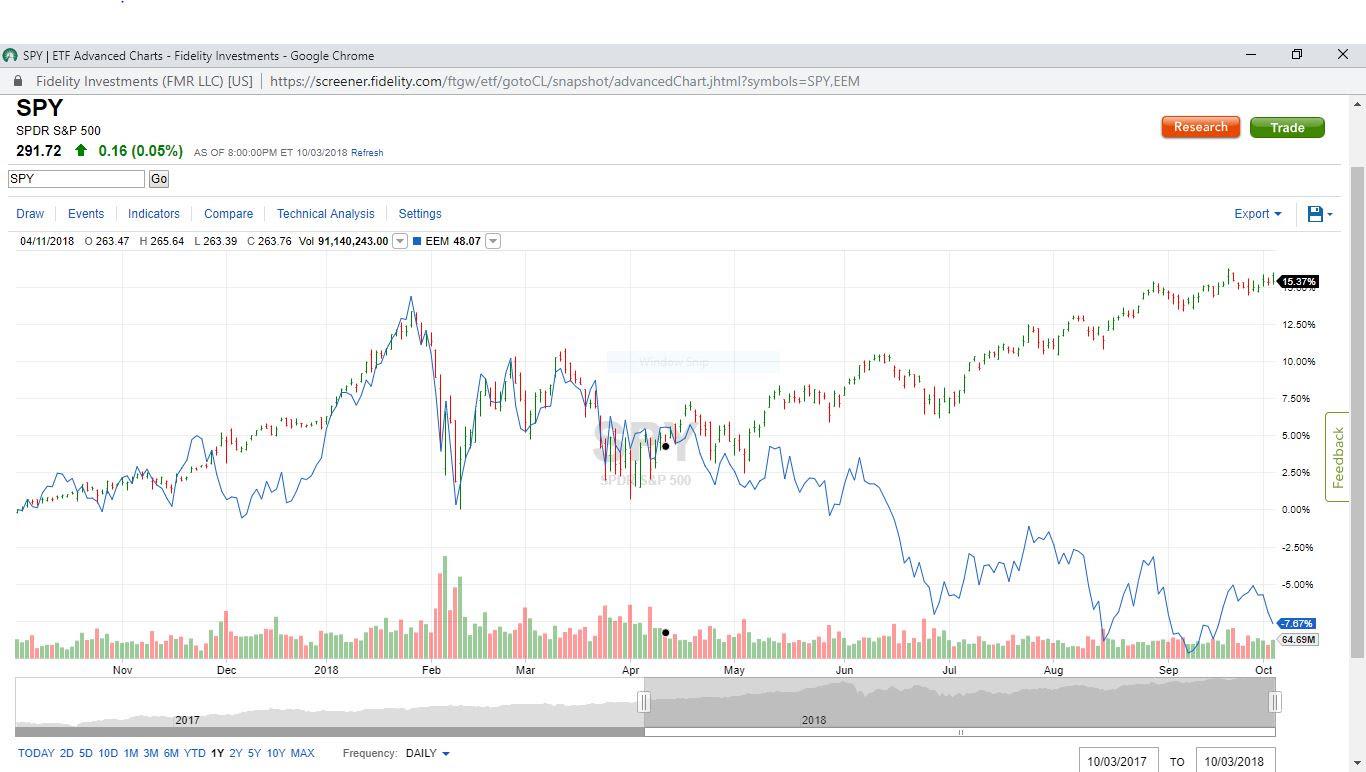
Of these, the tighter money supply/higher interest rates and emerging markets problems are the most concerning to me from a market standpoint. Stretched market valuations make it difficult to find stocks selling for good prices. As you can see from the following chart, while the U.S. market has happily marched higher, emerging markets have performed poorly. Of note on this chart is that emerging markets starting out the year more or less tracking U.S. stocks as usual. But six months ago there was a clear departure and since then U.S. stocks are up around 12%, while emerging market stocks are down around 12% - a 24% relative out-performance by U.S. stocks. Since a majority percentage of world growth depends on emerging markets, this may be a particularly ominous signal from the market.
During times of high asset prices like this, our strategy is to hold appropriate levels of cash or cash-like investments, while continuing our research disciplines to find the best value wherever it exists. I believe it is essential to have this “dry powder” at the ready to enable us to take advantage of downturns, corrections, and more reasonable prices when they inevitably occur.
The Best Part, A Stock we Like
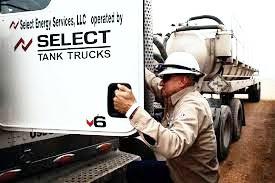
One stock to highlight for those reasons is Select Energy Services (NYSE: WTTR). There are several reasons that I believe the market has been treating this stock like swine in the hen house.
First, what a boring name. I remember a comment by Peter Lynch in one of his books mentioning that he became really interested in a stock or company when it had a boring name that didn't draw much attention. I would definitely put Select Energy Services in that boat!
Another is timing. The stock went public in April of 2017, a year after one of the largest bear markets in the oil market's history.
Misperception by the Market. WTTR is in the business of supplying water and water-related logistical support to oil and gas drillers in all the U.S. basins. Mr. Market may believe this is more of a commodity business and want to price it that way, but water is a scarce resource in many areas in which WTTR operates, so water rights take on a more valuable moat-like characteristic. The company operates under contract with customers. The water is not in a reservoir somewhere available to all.
There are lots of other reasons that we like this company.
WTTR has a rock solid balance sheet with almost no debt, only $80M, compared to short term assets of $475M. Although the stock is trading at around 12.5x my estimated current earnings, it returns free cash flow of an estimated $143M this year, for a free cash flow yield of around 15.5% at today's $900M market cap. I don't know about you, but 15.5% sounds pretty darn good to me compared to the S&P 500's 4.2% free cash flow yield. Especially considering WTTRs good moat and that it's trading at close to book value.
Another plus for WTTR is that they are the market leader in this space. Water logistics are becoming significantly more complex as single well fracking evolves to multi-well pad development where multiple wells are drilled and fracked from a single drilling pad. Such a project can use up to 250 million gallons of pre-frac water and such a project is likely beyond the capabilities of many smaller operators.
Of course there are risks. One over-hyped risk is Permian Basin takeaway capacity constraints. E&P (Exploration and Production) companies have been so successful with production growth in the Permian Basin that they have outstripped pipeline takeaway capacity and created a slowdown in growth. But this problem is ephemeral, and there are a few pipelines currently being built for added capacity which should be in place by late 2019 or early 2020. Since the Permian basin represents 37% of revenue, this is a real threat to revenue growth in the near future. But again at 15% free cash flow yield, we are getting paid well to wait.
Final Thoughts
Many thanks to Brittany Rowland and Brian Jones for their valuable ongoing contributions to research and technology.