Q3 2022 Market Update

A Time for Pessimistic Optimism
“There are two kinds of market forecasters: those who don’t know, and those who don’t know that they don’t know.” - John Kenneth Galbraith
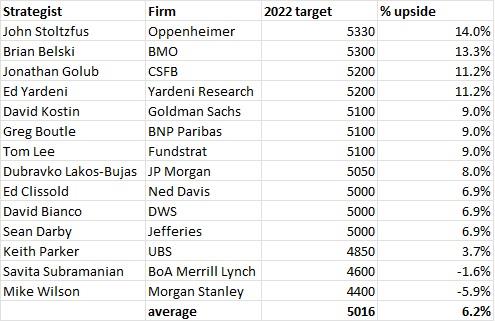
It’s interesting to occasionally review how the predictions from the best Wall St. economists and strategists panned out. Though the year is far from over, here are the forecasts for the S&P 500 for 2022.
S&P 500 Index Level Predictions for 2022
With an average prediction level of 5016 for the S&P 500, or a gain of 6.2%, I think it’s safe to say that with the S&P 500 currently at 3645, the forecasters are going to be off by a colossal margin. In January I also recorded that the average prediction for the 10-year Treasury bond yield forecast was around 2% for 2022. It appears they will whiff by a mile on that forecast as well, with the 10-year yield now above 4%, 100% higher.
To find out if 2022 was an outlier, I reviewed the predictions from the same prognosticators over the past 5 years. Keep in mind these are the top equity strategists and economists for these Wall St. houses. They are Ivy League MBA’s if not PhDs. Many run the bond and equity allocation strategies for the largest financial companies in the U.S.
Not only were they consistently wrong, the average was off by double digit percentages every year for the past 5.
We can safely conclude that the only forenamed individual who has been right is Mr. Galbraith.
So rather than try to determine the direction of the market (which we know is up an avg 10% long term), we research individual company fundamentals. We try to form a thesis about the short and long term prospects for the businesses. It’s great when short and long term are both very positive. If this is the case and the valuation is right, it makes decision making easier. But what do you do when the short term picture is poor and the long term is cloudy? That is unfortunately and fortunately the situation we find ourselves in today with many companies. The increase in the U.S. money supply by 40% since spring 2020 and a decade of low interest rates jacked up asset (stocks and real estate) prices to nutty levels and has definitely clouded the picture. Life was rosy for most companies in this environment. But that is changing now. You can hear it in the company earnings calls.
-Semi chip maker Mircon’s CEO used the word “unprecedented” repeatedly in their recent earnings call to describe the deteriorating demand picture for Micron’s products and a 23% reduction in revenue in the quarter.
-A recent earnings call for one of the largest homebuilders in America, Lennar, yielded the following cautions from the CEO: “The housing market has continued to weaken as expected in response to the Fed's too late but now very rapid and aggressive reaction to inflation. Homebuilding finds itself once again at the forefront of all that is happening in the economy, and the Fed's use of its interest rate tool to curtail inflation is certainly having the desired effect on the For Sale housing market….this suggests that even more challenges lie ahead.”
-A company we have owned for some time, STOR Capital, sold out to private equity for a mere 20% share increase over the prevailing market capitalization, stating: “This all cash transaction delivers a meaningful premium that provides immediate and certain value for our stockholders in a challenging market environment.”
-Two holdings, Applied Materials and Lam Research, both makers of semiconductor manufacturing equipment, were recently fundamentally impacted when the current Administration banned sales of their products to semi companies in China. China represented 33% of revenues and was one of the best growth markets.
So, we find ourselves in an environment of high uncertainty. This is where the contradictory “fortunate” part of the comment above comes into play. Often when the picture darkens and becomes very uncertain, prices of equities of outperforming companies come back to earth. The valuation picture becomes more appealing and the risk to the downside decreases to the point where an investment makes sense. We end up with what noted investor Monish Pabrai designates as his favorite investment scenario, high uncertainty with low risk. This is where we often get the setup for superior returns going forward and a small downside compared to a tremendous upside potential.
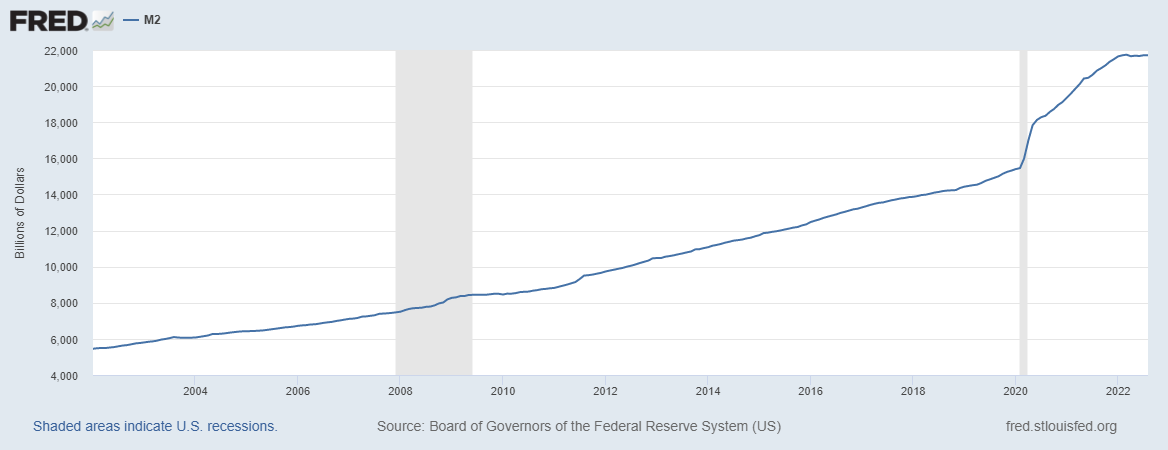
One question that hangs heavily on my mind is, “How much of the 40% increase in liquidity since Covid will the Fed drain from the economy?” As I’ve mentioned in past market updates, asset prices such as stocks and real estate do very well in a period of increasing liquidity. They should do poorly if the Fed decides in earnest to reverse this stimulus by selling more bonds than they purchase. As you can see from the chart below, though the Fed has articulated a planned reduction through bond sales without replacement, the money supply level has thus far not decreased. It has only leveled off.
Late last year and early this year, many of the stocks we owned hit our long-term price targets and we sold. We encountered an overpriced market that made finding replacement investments difficult and as a result we began to accumulate cash balances. T-bills yielding 3% to 4.5% have been attractive placeholders for cash.
We’ve been setting up price trigger alerts to let us know when individual stocks that we like are entering a buy zone. When the trigger is sprung due to a decline in price, we again research the fundamentals of the equity to find out if it warrants an investment and if so, how much. There have been many price triggers thus far this year, but few attractive investments due to deteriorating fundamentals. We are not afraid to sit and wait for the fat pitch.
Why do stocks go down when inflation and interest rates rise? I have a copy of a vibrant 1977 Warren Buffett 14-page article from Fortune Magazine titled, “How Inflation Swindles the Equity Investor.”
In it Buffett argues that bonds and stocks do poorly in inflationary periods due to rising interest rates, but the reason is misunderstood. He postulates that stocks in aggregate are very similar to bonds with an “equity coupon,” of around 12% pre-tax over time. “Essentially, those who buy equities receive securities with an underlying fixed return just like those who buy bonds.” However, the more one pays above book value (par), the less the equity coupon yields over time.
“Rising interest rates ruthlessly reduce the value of all fixed income assets.” If we think of stocks as a fixed income equity with a perpetual horizon, we can fully understand why rising interest rates force the longterm fixed income equity price to fall in order to compete on rate with the higher safe haven fixed income bond yield.
High inflation is not factored into the 12% coupon either. While the 12% rate is constant, it’s much more valuable in a 2% inflation environment (10% real return pre-tax) than a 7% inflation environment (5% real return pre-tax). Buffet: “The arithmetic makes it plain that inflation is a far more devastating tax than anything that has been enacted by your legislature.”
And finally, I love this comment, “Stock investors, who are in general not aware that they too have a “coupon” (like bond investors) are still receiving their education on this point.”
Classic Buffett. Who can say it better.
Inflation is bad for everyone. It’s awful for fixed income and stocks and terribly degrading to our wealth in general. We should all be hoping that the Federal Reserve, U.S. Congress and Administration will have the will to do what is necessary to bring inflation down to the target 2% level.
We wish you a wonderful fall.
=S Dee
All investments involve risk, including the possible loss of principal.
The comments, opinions and analyses expressed herein are for informational purposes only and should not be considered individual investment advice or recommendations to invest in any security or to adopt any investment strategy. The opinions and analysis are rendered as of publications date and may change without notice. The information provided in this material is not intended as a complete analysis of every material fact regarding any security, country, region, or market.