Q3 2025 Market Update

The Great Wealth Transfer from Baby Boomers
The Great Wealth Transfer from Baby Boomers
How will various assets be impacted by the transfer of wealth from Baby Boomers over the next 20 years?
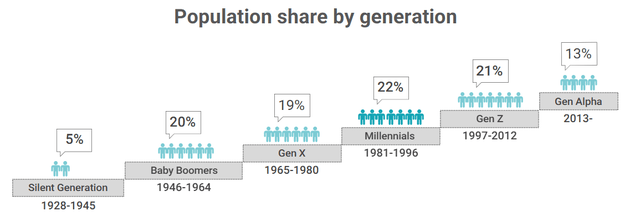
Over the next 20 years baby boomers will pass along over an estimated $70T to following generations. Baby boomers currently have around 50% of the nations wealth.
Baby boomers: $78.1 trillion (50%).
● Generation X: $46 trillion (29.5%).
● Silent Generation: $18.6 trillion (11.9%).
● Millennials: $13.3 trillion (8.5%).
● Generation Z: Insufficient data.
Currently over 10,000 baby boomers are retiring daily. The median age of a baby boomer is 71 years old. Roughly four baby boomers die every minute in the U.S. More than seven million Baby Boomers will pass away over the next two years, and this trend will accelerate in the years ahead.
.
What’s the impact of Boomers passing on various asset prices? Real Estate, Equities, Bonds, Metal and Crypto.
A Slight Headwind for Real Estate
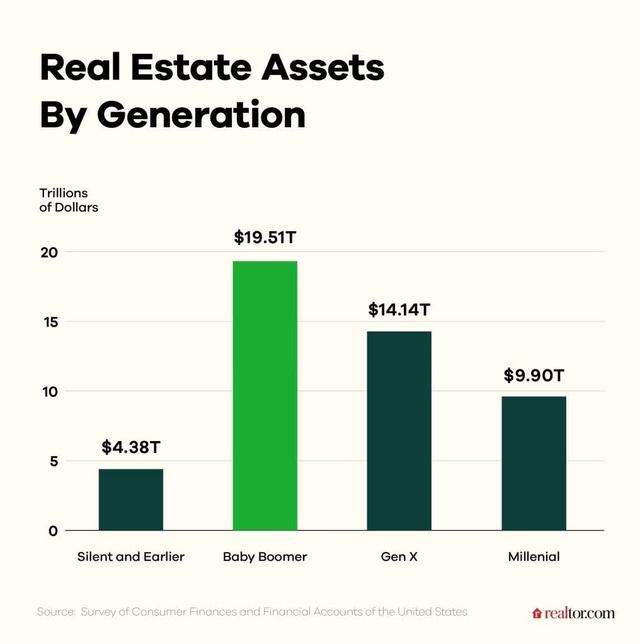
Boomers hold some 37% of the housing stock, 57% of vacation homes, and 58% of investment income-generating rental properties. As Boomers expire, up to 11 million homes will hit the market.
The transfer will likely happen over time gradually, muting severe shocks and providing more housing supply (according to FreddieMac.)
Baby Boomers held approximately half of all home equity in the United States as of 2024. This equates to some $17 trillion in home equity. In addition, Baby Boomers accounted for 42% of all U.S. home purchases last year.
In sum, we may see some softness in real estate, particularly in vacation homes, but most analysts believe the impact on real estate prices will be muted and the inventory absorbed by Millennials and Gen Z and positive for the housing shortage situation. However, there is potential for a shock to the down side.
Impact on the Stock Market - Stronger Headwinds The rapidly aging Baby Boomer generation will likely have more pronounced negative impacts on the stock market for several reasons. Boomers will be net sellers of stocks as they require a higher percentage of fixed income during retirement. The net ratio of investor capital is shifting in a negative direction.
Next, empirical studies have found a historical link between the age distribution and equity valuation metrics such as the price/earnings (P/E) ratio. A sustained P/E ratio decline for the market would be a serious negative - particularly from an elevated valuation such as we have today.
Economic growth is expected to slow as the working population shrinks. If we are unable to make up the gap through productivity gains, this will have a negative impact on corporate profits, and thus stock prices.
Corporate and Government Bonds
Private demand for corporate bonds is expected to remain solid or even grow in the next decade, as the huge Boomer cohort transitions fully into retirement and their investment focus turns to capital preservation and income generation.
So far, the evidence is that Boomer retirement has bolstered the investment-grade corporate bond segment, particularly shorter term for retail investors. Credit spreads are expected to remain tight.
Treasury bonds face solid demand over the next 10 years, but with offsetting increasing supply issuance from the government. The likely outcome is a high volume of Treasury supply met by global capital, with interest rates settling moderately higher than the ultra-low levels of the past decade but still constrained by worldwide saving trends.
Gold - Coin Toss but Up over the Long Term Millennials have recently emerged as enthusiastic buyers of gold. But Boomers own a larger share.
While boomers historically contributed to gold’s investor base, the generational handoff is unlikely to cause a crash in gold prices; younger investors and institutional allocations appear poised to uphold demand for the shiny metal.
Gold’s direction will likely be driven more by government deficits and dollar debasement than by Boomers passing on inheritance. For example, higher government deficits, debt and inflation due to increased entitlement healthcare spending and social security portends well for gold.
Bitcoin and Digital Assets - Strong Tailwinds
Boomers own very little of these assets while Millennials and Gen Z are much more comfortable and even enthusiastic owners of them. Some studies suggest that 90% of crypto assets are held by Millennials and Gen Z.
This stark generational gap implies that as boomers’ wealth transfers to their (often crypto-friendly) heirs, a greater share of the nation’s wealth could flow into digital assets.
In summary, as the boomers pass the torch, digital assets may claim a larger place in portfolios, potentially boosting Bitcoin and its peers – a distinct contrast to the past decades where older generations’ skepticism kept crypto on the fringe.
It doesn't take much to move the needle for bitcoin. There is no way to intrinsically value bitcoin, but comparison with gold may be useful. Bitcoin’s total market capitalization today is $2.2T vs. $28T for gold (approximated 7 billion ounces). One potential advantage of bitcoin over gold is a cap of 21 million bitcoin where gold supply increases 2% per year.
Conclusion
Real estate and particularly the stock market could see negative impacts from the largest wealth transfer in American history over the next 20 years. Within real estate we see vacation homes as potentially weak. Corporate bonds and other debt instruments should see support especially for issuances of medium term duration. Treasury bonds should see increased supply and demand. We see the big winner as crypto. Even if only a small percentage of that $70T finds its way to crypto and bitcoin, it will move the needle.


All investments involve risk, including the possible loss of principal.
The comments, opinions and analyses expressed herein are for informational purposes only and should not be considered individual investment advice or recommendations to invest in any security or to adopt any investment strategy. The opinions and analysis are rendered as of publications date and may change without notice. The information provided in this material is not intended as a complete analysis of every material fact regarding any security, country, region, or market.