Q4 2025 Market Update

Is Gold’s Rise a Canary in the Coal Mine
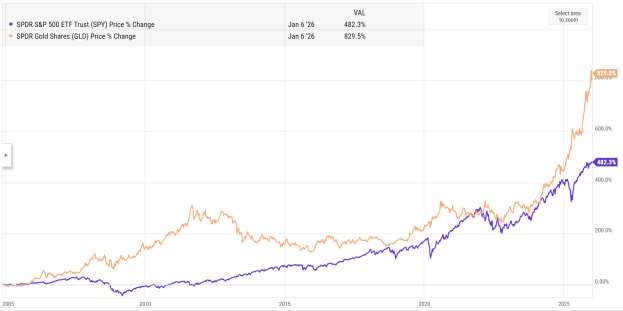
Gold had a remarkable run in 2025 and currently trades around $4600 per ounce. The increase has spawned many articles pointing to gold’s outperformance vs. stocks over 20-and 30-year periods. As the chart below shows, the price has recently gone parabolic, so we would not be a buyer at these levels.
Source: Ycharts
I’ve always enjoyed reading the commentary of Buffett and Munger. One disagreement though as an investor is Berkshire’s position on gold. While we aren’t gold bugs, we believe there is a place in a portfolio for gold and crypto as hedges against an ever-depreciating dollar due to average annual 6 to 7% money supply growth.
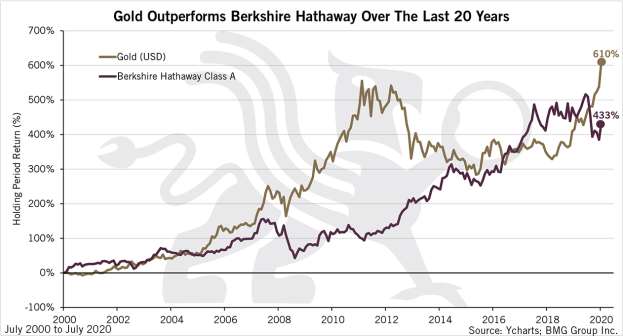
Here’s a famous Buffett snippet from the 2011 shareholders meeting: “I will say this about gold. If you took all the gold in the world, it would roughly make a cube 67 feet on a side…Now for that same cube of gold, it would be worth at today’s market prices about $7 trillion – that’s probably about a third of the value of all the stocks in the United States…For $7 trillion…you could have all the farmland in the United States, you could have about seven Exxon Mobils (XOM) and you could have a trillion dollars of walking-around money…And if you offered me the choice of looking at some 67 foot cube of gold and looking at it all day, and you know me touching it and fondling it occasionally…Call me crazy, but I’ll take the farmland and the Exxon Mobils.” Gold got the last word before Buffett’s retirement (following chart).
Source: Ycharts; BMG Group Inc.
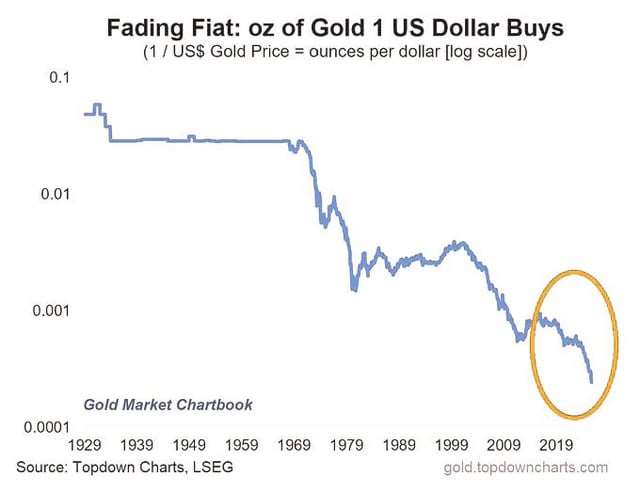
We think a bit differently, that gold is just real money, and that fiat currencies are priced in gold rather than gold priced in currencies. For example, the dollar is currently worth 0.000217 per gold ounce (following chart).
Central Bank Buying, Dollar Weaponization and De-dollarization Rebellion
The dollar’s decline against gold over the past few years has been pronounced. Events that caused the divergence are alarming for U.S. Bond prices in the future. In late 2022 gold was trading for around $1800 per ounce.. Then it started breaking all time high records in mid-2023 of around $2400 per ounce and has never looked back.
The term "weaponization of the dollar" refers to the strategic use of the U.S. dollar's dominant role in global finance as a tool of economic pressure and foreign policy. This includes measures like sanctions, asset freezes, exclusion from payment systems such as SWIFT, and restrictions on financial transactions to isolate targeted nations or entities.
In response to Russia’s invasion of Ukraine in February 2022, the U.S. and Europe froze Russian assets, meaning they stopped paying interest and barred access to the funds. The amount was around $300B. The G7 then loaned Ukraine $50B and backed it with frozen Russian assets. Then more of the same followed in the EU. In December 2025 the EU indefinitely froze 210B euro of Russian assets, to back further loans to Ukraine (no doubt to fund weapons purchases).
Without getting political, our opinion; this was a short-sighted poor policy decision – particularly by the U.S which uses treasuries sales to fund our trade and fiscal deficits. Other onlooking countries understandably took note. In response there has been a deliberate de-dollarization effort from the BRICS countries especially China, Russia, Brazil and India.
Gold is seen as a safe haven asset, immune to U.S. and European sanctions.
The gold price is benefiting from it’s new status as a major reserve asset for these countries. China is by far the largest buyer of gold during the 2022 through 2025 time period – purchasing 356 metric tonnes. Meanwhile, their U.S. treasury holdings have declined by $384B over the same period.
The U.S. has the largest government reserves of gold, while India is the largest owner of gold overall due to household ownership through jewelry. Jewelry use accounts for around 45% of the world’s gold.
Conclusion: Warning Signs from Gold
Gold is a forward-looking indicator. A sharp rise in gold prices often serves as harbingers of broader economic and financial stresses. These include inflation pressures, currency debasement, geopolitical instability, and fears of economic slowdown or recession.
For example, the 1979 boom year for Gold prices presaged a recession amid double-digit inflation and energy shocks.
It can also signal war. Pre-Russia-Ukraine invasion (2021–early 2022): Gold rallied sharply as tensions built.
Markets price in fear before events fully unfold—investors shift to non-credit-risk assets like gold to hedge against potential chaos.
Final Thought
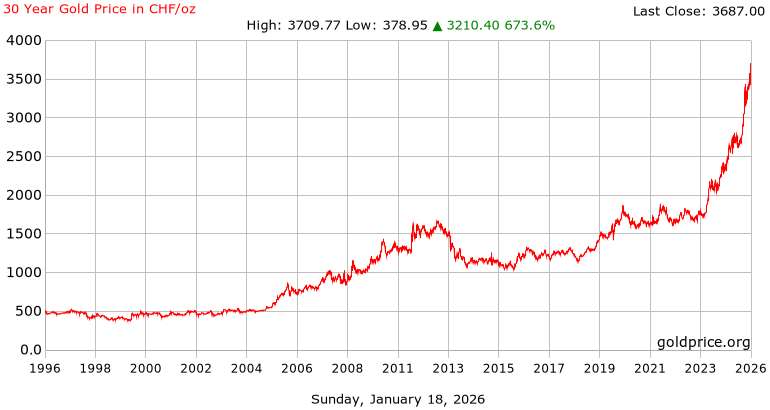
The famous quote, “all fiat currencies eventually go to zero vs. gold,” is on course to come true. In the following chart, the Swiss Franc hasn’t fared any better:
We’ll conclude with best wishes for a happy and prosperous 2026 and add that we are bullish on bitcoin and solana as gold and silver alternatives (stores of monetary value). We think it likely that bitcoin and solana trade independently of stocks in 2026 and beyond (outside a liquidity crisis).
All investments involve risk, including the possible loss of principal.
The comments, opinions and analyses expressed herein are for informational purposes only and should not be considered individual investment advice or recommendations to invest in any security or to adopt any investment strategy. The opinions and analysis are rendered as of publications date and may change without notice. The information provided in this material is not intended as a complete analysis of every material fact regarding any security, country, region, or market.